
Types of Seismic Waves
When an earthquake occurs, seismic waves propagate in all directions from the hypocenter. However, not all wave types are alike; important differences exist among them.
Seismic waves are classified into two broad groups according to how they travel through the Earth: body waves and surface waves.

Figure 1.
Body wavesare so called because they travel through the Earth's interior, sometimes reaching great depths. Surface waves, by contrast, propagate along the Earth's surface and do not generally penetrate deeply into the planet. Body waves appear in seismograms from earthquakes, while surface waves are more prominent in records of earthquakes that are not very deep.
Body waves are further divided into two types:
> P waves, or primary waves
> S waves, or secondary waves
P waves are named for being the first to arrive at a seismograph (they are the fastest), while S waves generally arrive second. Figures 2 and 3 show how each propagates. P waves alternately compress and expand the material through which they travel; S waves produce shear motion.

Figure 2.

Figure 3.
Surface waves are also divided into two types:
> Rayleigh waves
> Love waves
Rayleigh waves produce retrograde elliptical particle motion, as shown in Figure 4, whereas Love waves produce side-to-side motion resembling a snake (Figure 5).

Figure 4.

Figure 5.
Figure 6 shows a seismogram, with each wave type represented by a different color. The segment before the arrival of P waves is called the pre-event interval and usually contains ambient noise, such as ground vibrations caused by traffic and wind, which people do not normally notice.
The P waves arrive first because their average propagation speed is nearly twice that of S waves. The S waves typically have greater amplitudes than P waves.
Wave energy is related to amplitude. Therefore, for waves of the same period, a larger amplitude (for an explanation of amplitude and period, see https://www.lis.ucr.ac.cr/index.php?id=8) represents more energy. S waves often carry a significant portion of the shaking energy, and much structural damage is associated with their strong shear motion.
Surface waves travel at speeds lower than those of P and S waves. Like S waves, they may have larger amplitudes than P waves, but their periods are much longer. Figure 6 shows only the L wavebecause the record shown is from a horizontal component.
The coda is the decaying portion of a seismogram after the main wave arrivals, as the signal gradually returns to its original pre-event noise level. The coda may last a considerable time depending on the earthquake's size.
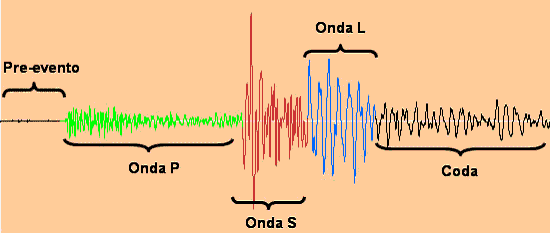
Figure 6.