
How Can Seismic-Wave Arrival Times Be Determined and Crustal Models Used?
How Can Seismic-Wave Arrival Times Be Determined and Crustal Models Used?
1. If I had a seismic station, a sensor, and a computer, how could I determine the exact arrival time of seismic waves? What data would the computer need, and how would I interpret the results and graphs?
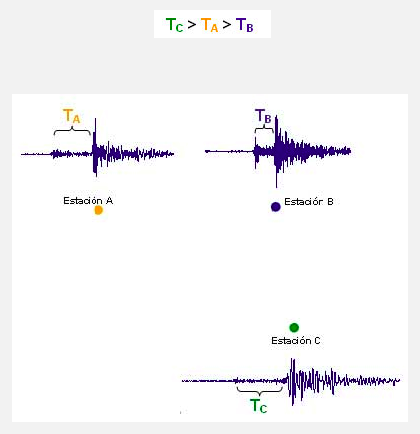
The instrument (the seismograph) provides the information needed. One can display the seismogram on a computer and identify when motion begins (the primary, or P, wave) and when the second, usually stronger, arrival occurs (the secondary, or S, wave). The difference between these arrival times—shown as Ta, Tb, and Tc in the figure—can be used to estimate the distance to the hypocenter. A very simple approximation is to multiply the time difference by a representative speed of 8 km/s. This is the basis for beginning to draw circles whose radii represent the estimated distances from the seismic stations to the earthquake source.
2. If information on subsurface layers is known, is a single station sufficient to determine the depth?
Using only one station would introduce a very large margin of error into these calculations.
3. Are models of seismic-wave speeds in the Earth's crust difficult to obtain? How many surveys are needed, at what spacing, and with what equipment?
Crustal models are very expensive because they require geophysical surveys using reflection and refraction seismology. For offshore areas, a ship would be needed to @page { size: 8.5in 11in; margin: 0.79in } P { margin-bottom: 0.08in } collect underwater information from geophones (survey seismographs).
The resulting models must be detailed enough to allow interpolation between places where measurements were not taken.