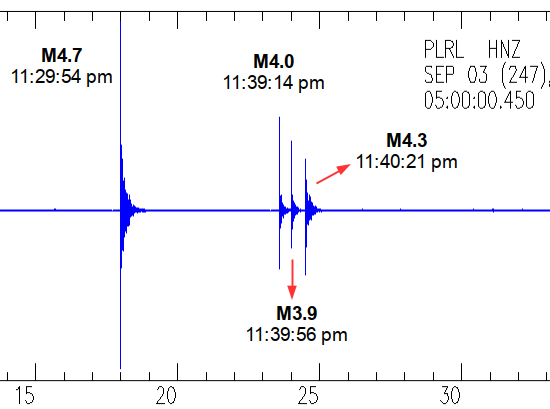
Why Do Earthquake Magnitude Estimates Differ?
Differences in earthquake magnitude estimates reported by various agencies
"Magnitude estimates for a given earthquake may differ among agencies because of differences in methodology, station availability, and uncertainties inherent in seismic data. Individual agencies use magnitude-estimation procedures designed to meet their particular needs and monitoring capabilities. Even for well-recorded events, differences of 0.2 or 0.3 magnitude units are common and reflect the uncertainty inherent in estimating earthquake magnitude." (https://www.usgs.gov/faqs/why-do-usgs-earthquake-magnitudes-differ-those-published-other-agencies)
In short, differences of 0.2 to 0.3 magnitude units are normal in seismology. For example, one agency may report a magnitude 4.3 earthquake while another reports magnitude 4.1. Both estimates would fall within an acceptable range of uncertainty. The differences can be greater for small earthquakes because their seismic signals may be heavily contaminated by noise, making them harder to interpret. There is generally greater agreement for large events because the signals are stronger and clearer, and more information is available, as more stations will have recorded the earthquake.