
Do Love and Rayleigh Waves Form During Explosions Used in Oil Exploration?
Do Love and Rayleigh Waves Form During Explosions Used in Oil Exploration?
Do explosions used in petroleum seismic exploration also produce Love and Rayleigh waves? How do these waves affect the ground?
An explosion during petroleum seismic exploration generates two main wave types: P and SV waves (and thus also Rayleighwaves). SV waves are a component of secondary waves (S waves), involving particle motion in a vertical plane, like P waves. In theory, only these wave types should be generated, but in practice SH and Lovewaves are also observed. This occurs for several reasons, including the fact that explosions are not perfectly symmetrical or spherical: heterogeneities in the surrounding medium distort that geometry. The transverse component of the released energy can therefore generate SH waves, and subsequently Love waves.
Departure from perfect symmetry is not the only mechanism. A sufficiently large explosion may also disturb surrounding tectonic stresses ("tectonic release"), generating these additional wave types.
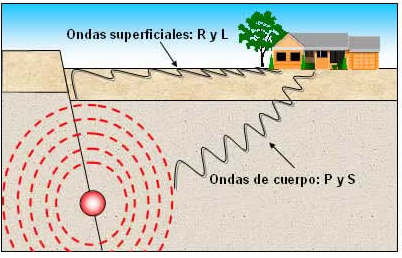
The smaller the explosion and the more homogeneous the medium, the less likely it is that SH and Love waves will occur. In practice, however, a perfectly homogeneous medium is an idealization rarely encountered on Earth.
How Rayleigh and Love waves affect the ground is a broad question without a simple answer. All seismic waves cause particles to move as they pass. Rayleigh-wave propagation resembles—but is not identical to—water-wave motion, with retrograde elliptical particle paths. Love waves involve side-to-side, snake-like horizontal motion. Both wave types have their greatest amplitudes near the surface, decreasing with depth; for that reason, they are called surface waves.