
Duration of Seismic Ground Motion
Duration of Seismic Ground Motion
The duration of earthquake shaking is a complex topic because it depends on many factors. At least three durations can be distinguished: fault rupture duration, instrumental duration of ground motion, and the duration perceived by people.
1. Rupture duration. This is the time required for a fault to rupture. For an M6.0 earthquake, the approximate rupture duration is 4–5 seconds; for an M7.5 earthquake, it may be 20–30 seconds. An M6.0 earthquake ruptures a much smaller area than an M7.5 event.
2. Instrumental duration: This is the duration measured by instruments installed at different sites (seismic stations). It depends on distance from the earthquake source and local geology beneath the station. For example, during the August 24, 2020, M6.0 Jacó earthquake, the longest recorded shaking occurred at the San Rafael Clinic in central Puntarenas, 50 km from the source. There, an accelerograph recorded approximately 104.4 seconds of motion (about 1 minute 40 seconds). At the Liceo de Jacó station, just 9 km from the epicenter, the duration was 77.5 seconds. These differences are clearly associated with local geology: soft soils in Puntarenas prolonged the shaking there.
3. Duration perceived by people: People perceive shaking differently. Motion that feels brief to one person may feel long to another. People also sometimes mistake the arrivals of P and S waves for two separate earthquakes, even though they are part of the same event. In general, people perceive ground acceleration. Those close to the epicenter may feel brief, intense shaking, while those farther away may feel gentler but more prolonged motion.
In earthquake engineering, prolonged strong shaking may cause nonlinear degradation of a structure and contribute to the buildup of excess pore pressure in loose, cohesionless soils, leading to liquefaction. One definition of strong-motion duration is the interval from the first to the last second during which an acceleration threshold of interest is exceeded. This threshold is often 0.05 g (approximately 50 cm/s2).
Beginning in October 2020, LIS-UCR automatic reports calculate duration as follows:
1. Use the three acceleration components.
2. Filter them over the 0.1–10.0 Hz frequency range.
3. Calculate the resultant vector.
4. Count the number of times acceleration exceeds 0.5 cm/s2.
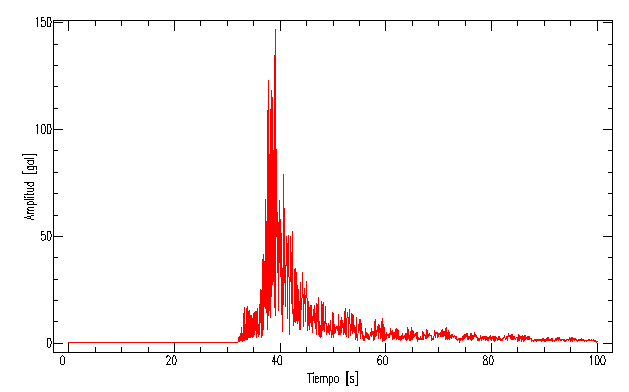
The following figure shows the resultant vector from the August 24, 2020, M6.0 Jacó earthquake at station PJCO. At this site, shaking lasted 77.5 seconds.
The next map shows the distribution of shaking duration at stations that recorded that earthquake. The longest shaking occurred at the San Rafael Clinic in Puntarenas.

This map corresponds to the June 25, 2019, M6.4 earthquake with an epicenter in Panama.

This map shows the May 12, 2019, M6.1 earthquake near Laurel de Corredores.
