Similar Earthquakes in Different Tectonic Settings
Similar Earthquakes in Different Tectonic Settings
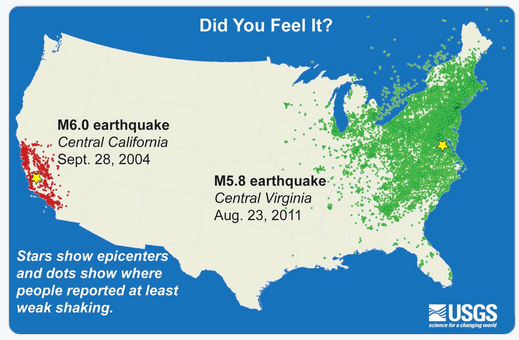
On August 23, 2011, an M5.8 earthquake occurred in the U.S. state of Virginia. Places where people reported feeling it are shown in green. For comparison, an M6.0 earthquake that struck California on September 28, 2004, is also shown; red dots indicate where people felt that event.
The map illustrates an important geological and seismological feature. On the U.S. East Coast, seismic waves travel greater distances while retaining amplitudes that can be felt by people because the rocks are relatively unfractured. These ancient rocks have become highly consolidated over millions of years. It is as though waves travel along a smooth, well-paved road with no potholes, allowing them to reach distant locations.
By contrast, rocks on the West Coast are generally younger, tectonic activity is ongoing, and the crust contains numerous faults. As waves pass through this fractured geology, they lose energy—so to speak—while navigating those obstacles.
Consequently, the 2004 West Coast earthquake, although slightly larger in magnitude than the 2011 East Coast earthquake, was not felt over such a broad area.