
Site Effects
Site Effects
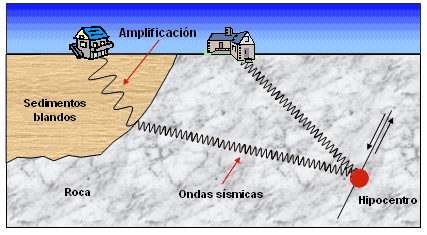
Site effects are changes in amplitude, duration, and frequency content that seismic waves undergo as they reach the ground surface. Generally, the softer the soil beneath a station, the greater the amplification.
Several techniques can be used to estimate soil amplification, or site effects. The results presented here were obtained by dividing the horizontal components by the vertical component (the H/V technique). This produces graphs like those shown above: for very firm soil or solid rock, the peaks tend to appear toward the left (short periods below 0.4 s); for soft soil, the peaks tend to appear toward the right (long periods above 0.4 s).

These reports plot both the site effect associated with the recorded earthquake and the average response at each station. The curves should not be expected to match exactly, because the average is more representative of the soil response than any single event. Nevertheless, general characteristics—such as amplification peaks and troughs at approximately the same periods—should be apparent.
The following image compares the amplification observed in Turrialba and Siquirres for an M4.3 earthquake at almost the same distance from both stations. This does not necessarily mean that soils in Turrialba amplified the seismic signal to slightly more than twice the level observed in Siquirres.

Earthquake Engineering Laboratory