
Why Do Aftershocks Occur After a Strong Earthquake?
Why Do Aftershocks Occur After a Strong Earthquake?
Aftershocks are smaller earthquakes that occur in the epicentral region after a larger event. They result from changes in stress caused by the rupture of the mainshock. Depending on the magnitude of the earthquake, aftershocks may continue for days or months.
An aftershock is always smaller than the mainshock. If an event initially classified as an aftershock proves to be larger than the original mainshock, the larger event becomes the new mainshock and the earlier one is reclassified as a foreshock.
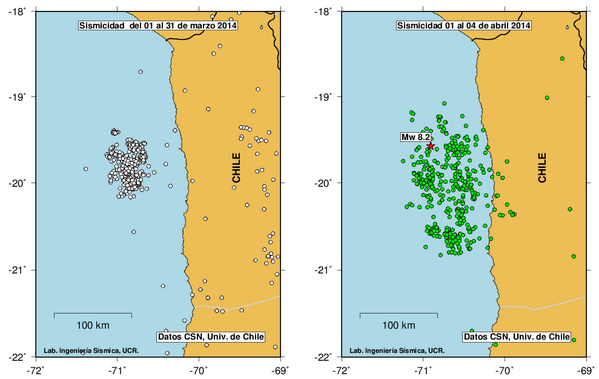
For example, the figure shows seismic activity before and after the April 1, 2014, Iquique earthquake in Chile. The first image shows regional seismicity during March (left), while the second shows activity from April 1 to April 4 (right). In this case, the March events are foreshocks, whereas events after April 1 are aftershocks.
Most aftershocks occur throughout the fault rupture area, either along the fault plane itself or along other faults within the region affected by stresses associated with the mainshock.