
Houses and Buildings
Houses and Buildings
The extent of damage an earthquake can cause to a house or building depends on the characteristics of the ground motion, the features of the structure, and the response of the ground. The combination of these three factors determines the risk to human-made structures.
Earthquakes are commonly characterized by a parameter called magnitude, which is related to the energy released. Magnitude does not depend on where it is measured; it is a property of the earthquake itself.
However, magnitude alone is of limited use when relating an earthquake's characteristics to possible structural damage, because shaking varies from place to place. A better parameter for this purpose is intensity. Intensity depends on the location and primarily describes the strength of ground shaking. Instruments called accelerographs are commonly used to measure ground acceleration during an earthquake and, consequently, the motion transmitted to structures supported by the ground.
Basic physics tells us that the force acting on an object equals its mass multiplied by its acceleration. Therefore, high acceleration during an earthquake creates greater additional forces on a house or building. Poor structural design that fails to account for these forces and the seismic hazards of a particular area can result in high vulnerability. Poorly designed buildings are likely to suffer significant damage in strong earthquakes. Even a sound design may not prevent damage or collapse if construction does not follow the plans or if inappropriate construction techniques are used.
Damage to houses and buildings depends not only on acceleration amplitude but also on the frequency of seismic motion. Every structure has a natural frequency of vibration. If the dominant frequencies of ground motion are close to that natural frequency, severe damage may occur. Small buildings generally have higher natural frequencies and may therefore be more vulnerable to nearby earthquakes, which often contain higher-frequency motion. Taller buildings usually have lower natural frequencies and can be more vulnerable to distant earthquakes, whose motion may contain relatively lower frequencies.
Ground response can also be critical to the damage suffered by structures. Earthquakes may trigger landslides, ground cracking, liquefaction, and settlement, causing serious deterioration or even total collapse. Consider what happened in Santa Tecla, El Salvador, in 2001, when a hillside landslide buried numerous homes and caused hundreds of deaths.
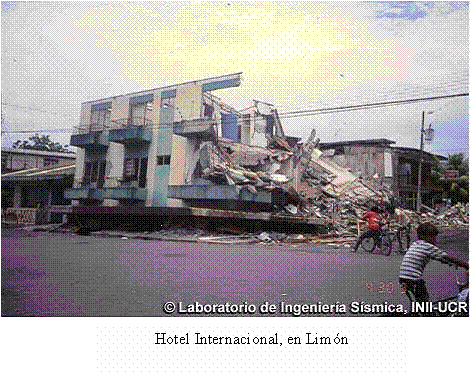
Figure 1.
The photograph shows the collapse of the Hotel Internacional in Limón during the 1991 earthquake.
Adobe structures.
During the colonial period, the Spanish introduced the widespread use of adobe for housing in Latin America. Few such buildings remain in Costa Rica today, but they are still common in some other Latin American countries.
Adobe is made by mixing clay and sand with water to form a paste that can be shaped, usually into bricks. The bricks are dried until they harden and are then used in construction. Straw is sometimes added to improve cohesion and reduce cracking during drying.
The problem with adobe is that walls built from this material generally cannot resist large lateral forces. Such forces are common during earthquakes, so adobe structures may suffer severe cracking or even collapse.

Figure 2.
The photograph shows the effects of the Alajuela earthquake on an adobe house in the city center. Note the cracks in its walls.