
Landslides and Soil Liquefaction
Landslides and Soil Liquefaction
 |
 |
 |
Liquefaction is a phenomenon that sometimes occurs during earthquakes, especially in sandy soils containing large amounts of water. In these soils, shaking rearranges sand grains into a denser configuration. Water between the grains is then forced upward under high pressure, carrying sand to the surface and forming small "sand boils" or "mud volcanoes."
Liquefaction can cause severe damage to structures, including tilting and settlement, because it weakens the soil supporting them. The term refers to the fact that the soil temporarily behaves like a liquid.
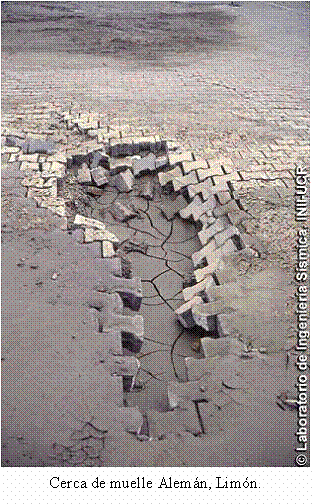
The first two photographs show effects of the Limón earthquake. In the first, the small "mud volcanoes" through which water and sand emerged are clearly visible—an unmistakable sign of liquefaction. Note the road damage. The second photograph shows damage to the German Wharf.
The third photograph shows damage from the 1990 Cóbano earthquake. It illustrates vertical displacement of the Municipal Building of Puntarenas due to ground settlement.
Landslides

Figure 4.
A landslide is a sudden downslope movement of material at the Earth's surface. Landslides commonly accompany earthquakes because shaking can dislodge soil and rock, particularly on mountain slopes.
The steeper the slope, the more prone the material is to sliding downward. Soil water content also influences landslide susceptibility. Greater water saturation reduces the stability of some materials by lowering their effective strength. Conversely, compact, rocky ground is generally less likely to detach and slide.
The photograph shows a landslide triggered by the Limón earthquake in the Talamanca mountain range, in the Sixaola area. The surrounding terrain is very steep, which contributed to the failure.