
Surface Rupture of Seismic Faults
Surface Rupture of Seismic Faults
Earthquakes caused by movement along faults can rupture the Earth's surface. This is more common in large-magnitude events in which the rupture extends throughout the seismogenic zone, potentially reaching the upper mantle. However, surface ruptures associated with moderate-magnitude earthquakes have also been documented in recent years.
Asphalt road offset by surface rupture during the 2019 M4.9 Le Teil earthquake in France (https://www.nature.com/articles/s43247-020-0012-z)
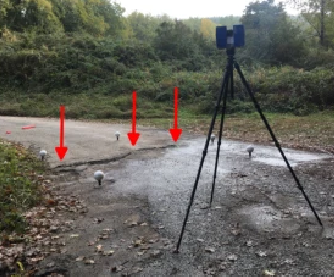
Surface rupture from the 2010 M4.9 Pisayambo earthquake in Ecuador (https://agupubs.onlinelibrary.wiley.com/doi/full/10.1002/2017JB013928).

The M7.3 Landers earthquake of June 1992 displaced this road in southern California, United States, by a total of 1.5 m.

This waterfall was created by fault movement during the Mw 7.7 earthquake that devastated Taiwan in the early hours of September 21, 1999. The earthquake claimed 2,297 lives and destroyed approximately 6,800 buildings.

A house that remained standing during the 1995 Mw 6.9 Kobe earthquake in Japan. It is now part of a museum. Here, the fault responsible for the earthquake produced about 2 meters of displacement in the direction indicated by the arrows. Farther north, beneath the city of Kobe, the earthquake caused more than 5,000 deaths and destroyed many buildings.
 Fault scarp formed in the courtyard of a secondary school in Bailu during the 2008 Wenchuan earthquake in China, which had a magnitude of Mw 7.9. The school buildings were well constructed and less than a year old at the time; they did not collapse despite being close to the fault.
