
Seismic-Wave Amplification
Seismic-Wave Amplification
A well-established phenomenon in seismology is that seismic waves tend to increase in amplitude when they travel through soft or poorly consolidated sediments.
Figure 1 shows seismic waves leaving the hypocenter with similar amplitudes. Those reaching the house on the right undergo relatively little change along their path, whereas those reaching the house on the left are modified.
Both the amplitude and frequency of the latter waves have changed. Their amplitudes are now greater than when they traveled through solid rock. Their frequency has also decreased, meaning that the spacing between successive peaks has increased.
Buildings on soft sediments such as clay, silt, alluvial deposits, and floodplains may experience much stronger shaking than those on lava rock or limestone, for example.
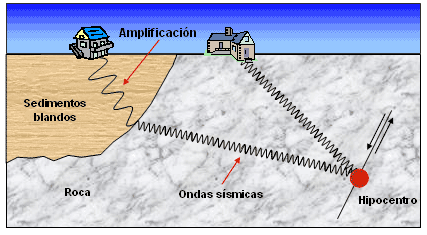
Figure 1.
Figure 2 illustrates this effect during the January 31, 2019, Mw 5.3 earthquake. Its epicenter was more than 80 km from Golfito. The city has two stations: PGOL at the University of Costa Rica (UCR) and PGTO at the technical college. The stations are approximately 1 km apart. The technical college site experienced shaking four times stronger than the UCR site.
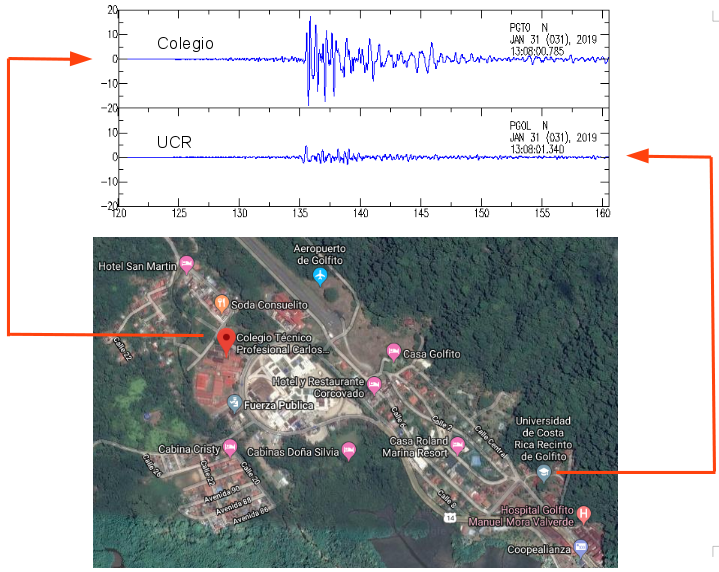
Figure 2.