
Earthquake Energy
Earthquake Energy
Energy
The largest earthquake ever recorded by instruments was the 1960 Chile earthquake, M9.5. It ruptured a fault approximately 800 km long and 200 km wide, with maximum displacement of 20 m. In other words, both fault blocks moved by as much as 20 m over an area described in the source as 1,600 km. To understand the amount of energy released, consider that it exceeded the combined energy of all atomic bombs detonated up to that date (1).
Energy is the capacity of a physical system to perform work. The erg is a unit of energy. The 1960 Chile earthquake released approximately 1.122E+26 ergs, while the 1991 M7.7 Limón earthquake released 2.239E+23 ergs.
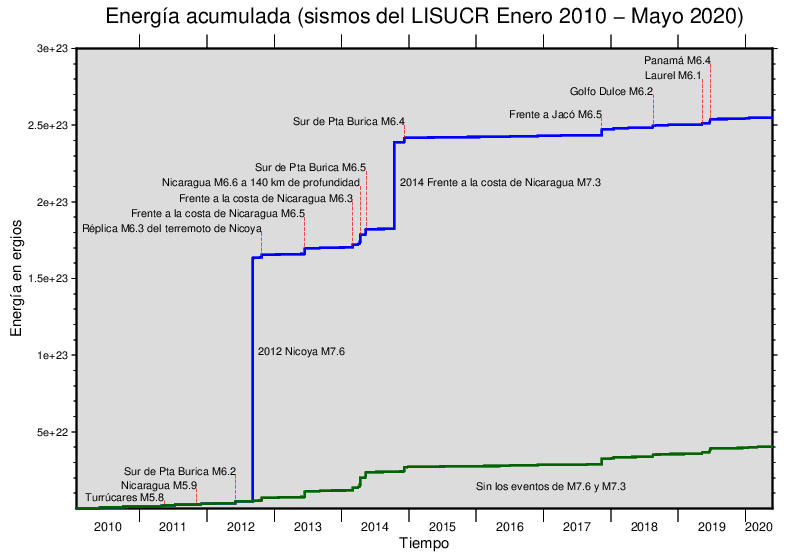
The following graph shows the cumulative energy of earthquakes recorded by LIS-UCR from January 2010 through May 2020. The energy released by each event is added chronologically to the accumulated total. When a major event occurs—such as the 2012 Nicoya earthquake (M7.6) or the 2014 Nicaragua earthquake (M7.3)—a marked jump appears in the graph.
The green curve shows how the cumulative energy would have evolved if the M7.6 and M7.3 events had not occurred.
This illustrates that larger earthquakes release far more energy. It would take nearly 32 magnitude 6 earthquakes to equal the energy released by a single magnitude 7 earthquake.
(1) Reference:
Stein and Wysession, An Introduction to Seismology, Earthquakes, and Earth Structure, Blackwell Publishing, 2003