
Instrumentation: The Seismograph
Instrumentation: the seismograph and accelerograph at LIS-UCR
For many centuries, people experienced earthquakes without understanding how or why they occurred. As a result, earthquakes were the subject of considerable speculation and mythology.
One traditional Japanese belief held that the world rested on a fish (called Namazu in Japanese, or catfish in English) and that earthquakes occurred when it moved its fins (Figure 1).

Figure 1.
In the year 132 A.D, the Chinese inventor Zhang Heng devised an ingenious instrument that indicated the direction in which an earthquake had occurred (Figure 2). Eight dragons were arranged around a bronze vessel, each holding a small ball in its open mouth. Inside the vessel was a pendulum connected to the balls by small bronze rods. Eight frogs with open mouths were positioned below the dragons. When the ground shook, the pendulum moved, releasing one of the balls into a frog's mouth and indicating the earthquake's direction.
 |
This was one of humanity's first attempts to understand earthquakes more systematically. Instruments like that of Heng, which do not produce a time record, are called seismoscopes.
An instrument that records ground motion is called a seismograph. It operates on the inertia of a mass suspended from a rigid support (Figure 3). During an earthquake, the mass tends to remain stationary while the support moves with the ground. A rotating drum moves at a steady speed, like the second hand of a clock. The trace drawn on the drum records seismic-wave motion over time and is called a seismogram.
Because the ground moves in all directions, seismological stations use instruments that record both horizontal and vertical components.

Figure 3.
The first modern seismograph was developed in 1880 by the English scientist John Milne. Since then, seismographs have evolved into highly sophisticated and sensitive instruments capable of recording earthquakes at great distances.
An accelerograph, as its name suggests, records ground acceleration during an earthquake. Such instruments are generally used to study strong ground motion from major events because they are designed to withstand intense shaking. The Earthquake Engineering Laboratory (LIS) network consists of accelerographs.
LIS originally used SMA-1 instruments, such as the one shown in Figure 4. These operated with photographic film. When an earthquake occurred, a narrow beam of light exposed the film, recording the passage of seismic waves. The film was then developed, digitized, and analyzed using computers.

Figure 4.
Around 2000, modern ETNA or K2 equipment (Figure 5) was used. These instruments functioned as specialized computers designed to record strong earthquakes. The data were stored on internal hard drives and could be retrieved quickly with a laptop.

Figure 5.
In 2010, REFTEK instruments were acquired (center of Figure 6). They stored data digitally on removable media and could also transmit records over the Internet. NANOMETRICS instruments (green in Figure 6) and GURALP instruments (cylindrical in Figure 6) were added later, completing the LIS-UCR network described here.
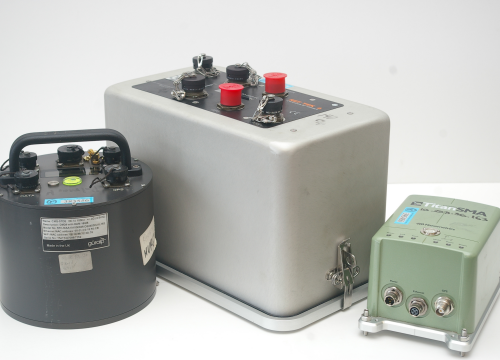 Figure 6.
References:
Bulletin of the Seismological Society of America. Vol. 59, No. 1, pp. 183–227. February 1969