
Fault: A fracture in the Earth's crust along which blocks of rock on opposite sides have moved relative to one another.
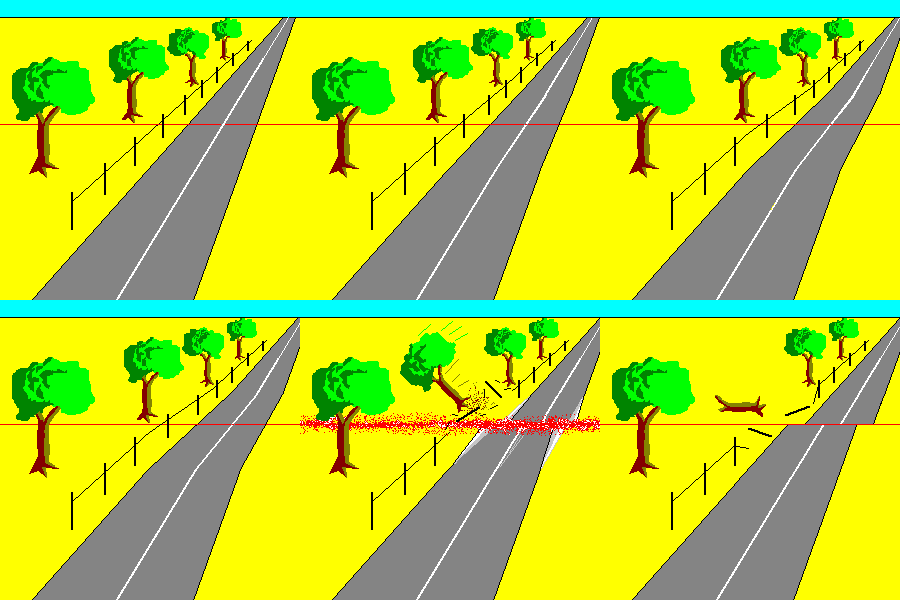
The sudden movement generates seismic waves that propagate in all directions and produce the shaking experienced during an earthquake.
There are three basic types of faulting:
Normal: This type of fault occurs when one block moves downward under gravity and extensional forces acting on the crust. Tectonic forces pull the crust apart in a direction perpendicular to the fault. |
|||||||
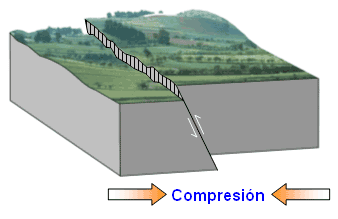
Reverse: This type of faulting occurs when one block is pushed upward by compressional forces acting on the crust. Tectonic forces compress the crust in a direction perpendicular to the fault. The 1991 Limón earthquake was caused by reverse faulting. The approximately 1 m of coastal uplift still visible today occurred because the block that rose was on the Costa Rican side of the fault.
|
|||||||
|
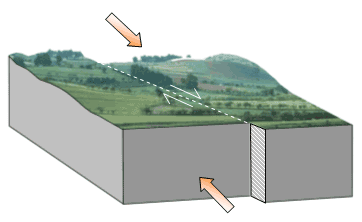
Strike-slip: This is the type of faulting that occurs when tectonic forces act in opposite directions on the two sides of a fault, parallel to its trace. The blocks therefore move horizontally relative to one another. The Alajuela earthquake was generated by strike-slip faulting. |


Earthquake Engineering Laboratory