
Using observed recordings of several earthquakes from 2019 onward, the propagation of P waves (black) and S waves (red, approximated for simplicity using Ts = 1.73 × Tp) was calculated and compared with the times when MASLIS notifications were posted to social media. Wavefronts are plotted at two-second intervals from the earthquake origin at the epicenter, which is assigned time zero.
The time of the first MASLIS notification is denoted TN. The earthquake origin time is denoted TO, corresponding to the beginning of rupture and seismic-wave propagation. The difference was used to estimate the "shadow zone": the area where shaking occurs before MASLIS sends its notification.
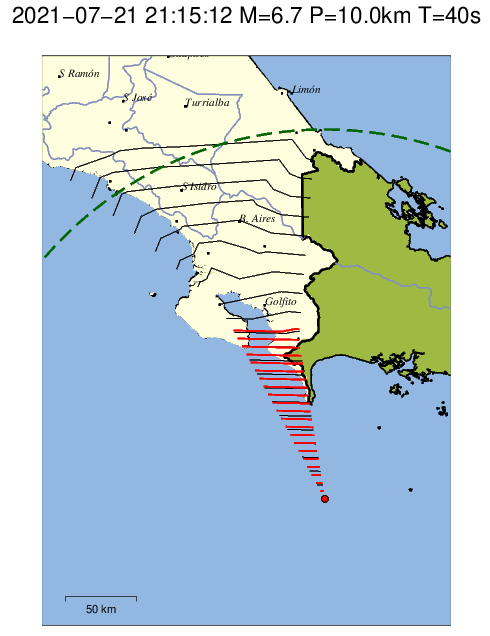
Figure 1.
EVENT No. 1: TO: 2021-07-21 21:15:12 TN: 2021-07-21 21:15:52
Trigger threshold: JMA = 2 at more than 3 sites.
Figure 1 shows one of the strongest earthquakes recorded. It occurred south of Punta Burica and had a magnitude of 6.7. P waves reached Laurel de Corredores (PLRL, the nearest station) at 21:15:35. According to USGS data, the earthquake origin time was 21:15:12. The P waves therefore arrived at PLRL about 23 seconds after rupture began.
In 2021, MASLIS was triggered when JMA intensity reached or exceeded 2 at three stations. On this occasion, the first notification was sent at 21:15:52, when intensity reached JMA 2 at PLRL, Liceo de Finca Naranjo (PFNR), and Colegio de Puerto Jiménez (PJMN) in southern Costa Rica. This first alert corresponded to a radius of approximately 250 km. At that moment, P waves were reaching Quepos and S waves had already reached Laurel de Corredores.

Figure 2.
EVENT No. 2: TO: 2023-04-04 22:18:12 TN: 2023-04-04 22:18:41
Trigger threshold: JMA = 1 at more than 3 sites.
Figure 2 shows a similar case from April 4, 2023, for a magnitude 6.4 earthquake originating at 22:18:12. By then, the MASLIS activation rule had changed: the system was triggered when three sites exceeded JMA intensity 1. The earthquake triggered MASLIS at 22:18:41, about 29 seconds after the origin time. The first stations to trigger were PFNR (Finca Naranjo), PCNL (Ciudad Neily Fire Station), and PLRL (Laurel de Corredores).
When MASLIS was activated, P waves were about to reach Buenos Aires and Puerto Cortés. S waves (red) were approaching PLRL. The first notification was clearly issued earlier in this case than in Figure 1 because the triggering threshold at three sites had been lowered from JMA 2 to JMA 1.
For the 2021 M6.7 and 2023 M6.4 earthquakes, MASLIS was apparently triggered by P waves alone. This can be explained by the sufficiently strong and prolonged wave trains generated by these moderate, relatively distant earthquakes, which exceeded the required JMA threshold.

Figure 3.
EVENT No. 3: TO: 2023-02-18 08:24:12 TN: 2023-02-18 08:24:21
Trigger threshold: JMA = 1 at more than 3 sites.
On February 2, 2023, a magnitude 5.3 earthquake occurred near Varablanca in Heredia. When MASLIS was activated, approximately 9 seconds after the origin time, S waves were reaching San José, Grecia, Coronado, and Ciudad Quesada. The notification radius was approximately 50 km.

Figure 4.
EVENT No. 4: TO: 2023-07-12 05:58:41 TN: 2023-07-12 05:58:50
Trigger threshold: JMA = 1 at more than 3 sites.
The event in Figure 4 is important because it occurred in a densely instrumented area. Even so, the first MASLIS notification was issued 9 seconds after the origin time. By then, S waves would have reached Orotina de Alajuela to the west and Paraíso de Cartago to the east. Because the epicenter was so close to the capital, the notification arrived after shaking had already been felt. The green circle has a radius of about 50 km.

Figure 5.
EVENT No. 5: TO: 2020-08-24 21:51:08 TN: 2020-08-24 21:51:28
Trigger threshold: JMA = 2 at more than 3 sites.
The event in Figure 5 was an M6.0 earthquake off the coast of Jacó in 2020. The minimum requirement to trigger MASLIS was three stations registering JMA intensity 2. Sparse instrument coverage along the Pacific coast can delay system activation. Although there were two stations in Jacó (PJAC at the Red Cross and PJCO at the Jacó school), a third station in or near the city would have been needed to issue an early alert.
On that day, station PJAC was offline, leaving only PJCO available. The next station to trigger was Parrita, followed by Caldera. By then, P waves were reaching Nicoya, Cañas, Guápiles, and Turrialba, while S waves were reaching Jicaral, Atenas, Acosta, and Quepos. The green circle has a radius of 115 km.
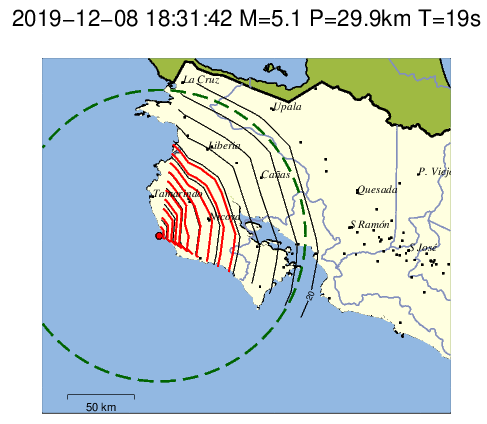
Figure 6.
EVENT No. 6: TO: 2019-12-08 18:31:42 TN: 2019-12-08 18:32:01
Trigger threshold: JMA = 2 at more than 3 sites.
The event in Figure 6 had an epicenter near that of the September 5, 2012, Nicoya earthquake (M7.6). In this case, the first notification time (TN) was 19 seconds after the origin time (TO). P waves (black) would have reached La Cruz to the north and Puntarenas to the east. MASLIS activation required JMA 2 to be recorded at three sites; here, that criterion was met at stations in Nosara, Santa Cruz UCR, and Colegio de Santa Cruz.
S waves (red) would have reached Bahía Culebra to the north and Carmona de Nandayure to the east. The travel time to San José would be 9 seconds for P waves and 29 seconds for S waves.
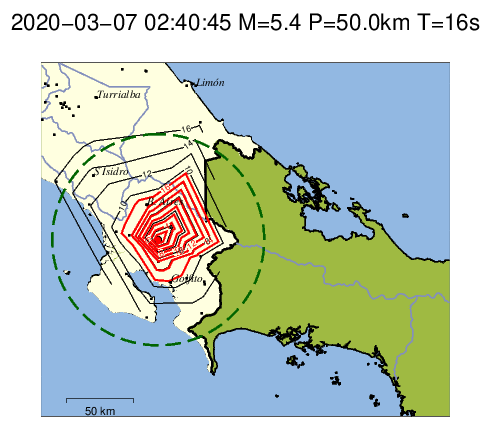
Figure 7.
EVENT No. 7: TO: 2020-03-07 02:40:45 TN: 2020-03-07 02:41:01
Trigger threshold: JMA = 2 at more than 3 sites.
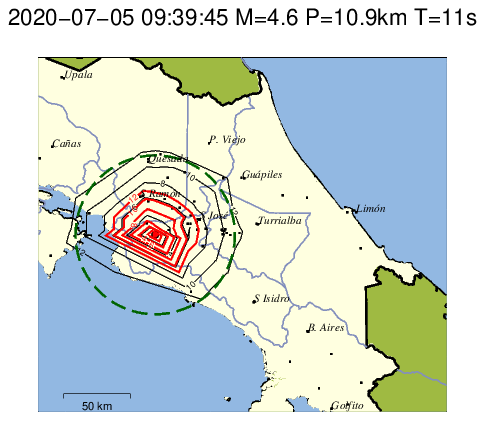
Trigger threshold: JMA = 2 at more than 3 sites.


This was a deep earthquake directly beneath the capital. The first notification was issued 26 seconds after TO. By then, its radius was 150 km, reaching Upala (AUPA) to the north and La Palma (PLPM) in the Southern Zone. Because of the depth, seismic waves arrived at many stations at nearly the same time, and people felt the shaking across a very broad area almost simultaneously.

