
MASLIS calculates earthquake magnitude using three methods. The first applies the methodology used by the automatic system, but considers only the first few seconds of P waves rather than the entire record.
The second method calculates peak ground displacement (PGD) from P waves, using a three- or four-second window after their arrival. An empirical relationship exists between PGD and magnitude, as shown in Figure 1 using LIS records from recent years.
The gray points represent individual measurements for each event and magnitude on the vertical component at each station. The red point is the average of the individual measurements. The values calculated from the fitted-line equation are valid up to approximately M6.5.
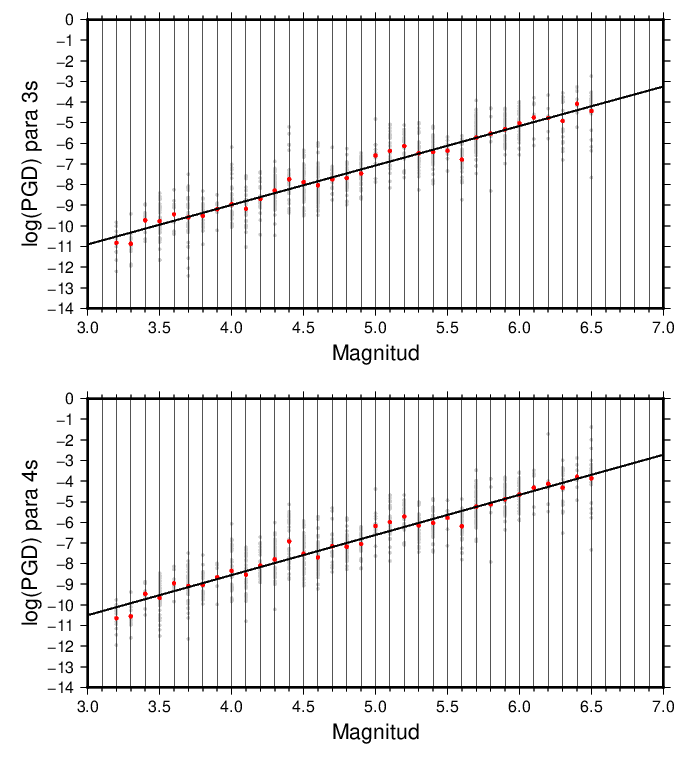
Figure 1
log(PGD) = 1.9141 M - 16.6441 for 3 s
log(PGD) = 1.9452 M - 16.3374 for 4 s
The third method calculates the characteristic period (Tc) and multiplies it by PGD. Tc is defined by the following equation:


where u(t) is the displacement record. The product Tc × PGD also has a direct relationship with earthquake magnitude (Figure 2). Unlike the previous two methods, however, it does not require calculating the epicenter location.

Figure 2
log(Tc*PGD) = 1.7433 M - 19.5588
All three calculations are performed simultaneously, and the highest value is selected. Using that information and data derived from the matrix shown in Figure 3, the expected intensity is calculated for San José only (Figure 4).

Figure 3.
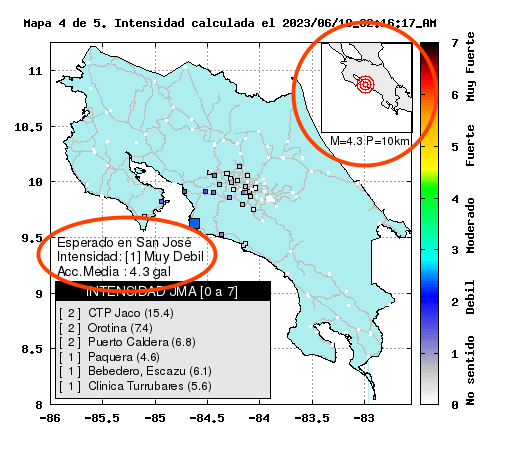
Figure 4.