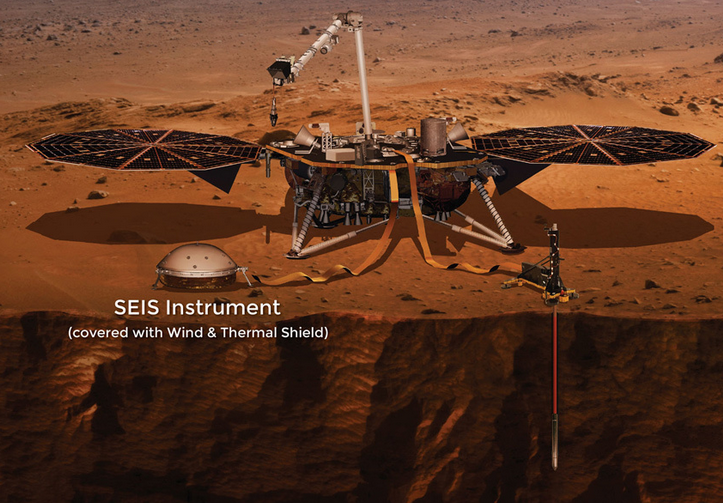
NASA's InSight lander arrived on Mars on November 26, 2018. Among its instruments was a seismograph intended to detect seismic activity, or "marsquakes." This activity can provide information about the Red Planet's internal structure. Mars is much smaller than Earth. It may once have experienced tectonic and volcanic activity similar to Earth's, but its smaller size may have caused it to cool more rapidly. In other words, the internal energy driving tectonic activity may have diminished earlier than on Earth. Today, Mars appears as a vast red desert because of the iron oxides on its surface. Little is known about its interior, which explains the interest in this mission and especially in the first records from its seismograph. As seismic waves travel through the crust, they change in ways that can reveal internal layers and even liquid material.
InSight did not carry the first seismograph sent to Mars. NASA's Viking missions in the 1970s also carried seismographs. The instrument on Viking 1 did not work, while Viking 2 suffered from high levels of wind-related noise and low sensitivity, preventing the expected measurements. Taking that experience into account, the new instrument aboard InSight was developed by France's Centre national d'études spatiales (CNES). It is called SEIS, for Seismic Experiment for Interior Structure. SEIS is so sensitive that it was expected to detect not only tectonic marsquakes, but also meteoroid impacts, microseismic activity, and motions in the Martian crust associated with the planet's moons (information from Wikipedia, NASA's Mars InSight Mission, and https://gizmodo.com/how-engineers-tested-the-super-sensitiv…).